V1.0.2 PRE-RELEASE

Open-Source Computational Lithography Benchmark & Workflow

Bridging the gap between high-dimensional tensor optimization and semiconductor manufacturing constraints with a standardized, model-agnostic evaluation framework.

LITHO_OPTIMIZER_VIS
memory

EUV Lithography Visualization

GitHub Stars 2.4k+
Contributors 85+
Datasets 12 TB
Standard Metrics 42

Foundational Features

database

Unified Data Access

Access petabyte-scale semiconductor layout data through a unified API. Support for GDSII and OASIS formats with high-performance C++ backend loaders.

analytics

Standardized Metrics

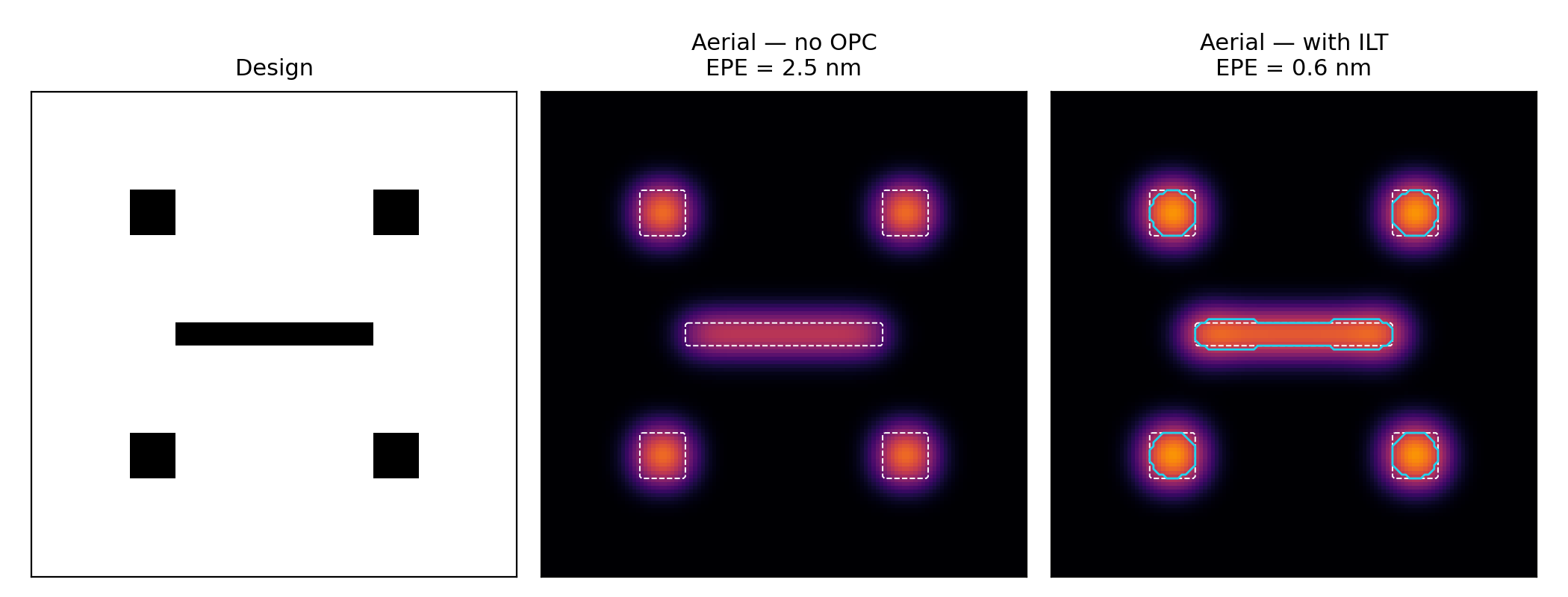
EPE, PV Band, and ILS scoring across all models for consistent benchmarking.

verified

Manufacturing Compliance

Built-in DRC and MRC verification kernels.

account_tree

OASIS Workflow

End-to-end support from layout to mask fabrication data.

extension

Model-Agnostic

Compatible with PyTorch, TensorFlow, and custom C++ engines.

Architecture Stack

LEVEL 05 Global Leaderboard & Insights trophy
LEVEL 04 Optimization Engine (ILT/OPC) psychology
LEVEL 03 Lithography Simulation Kernel settings_input_component
LEVEL 02 Standard Metric Evaluation rule
LEVEL 01 Multi-Source Data Fabric layers

Integrate in Seconds

Our Python SDK provides a seamless interface for researchers. Load complex lithography patterns and run industry-standard metrics with minimal boilerplate.

  • check_circle Seamless pip installation
  • check_circle Hardware accelerated kernels
  • check_circle OASIS/GDSII Parser built-in
benchmark_eval.py content_copy
# Install the hub
pip install openlithohub

# Run evaluation
import lithohub as lh

dataset = lh.load_dataset("iccads-2023")
model = lh.models.ILTModel("v1_resnet")

results = lh.evaluate(
    model=model,
    data=dataset,
    metrics=["epe", "pv_band", "runtime"]
)

print(results.summary())

Push the Boundaries of Lithography

Join hundreds of researchers contributing to the open-source future of semiconductor manufacturing.